First principles
What has changed at the level of science or engineering—and why is it possible now?
EARLY-STAGE INVESTOR · PARTICLE PHYSICIST
Where frontier technology
meets real-world industry.
I invest in early-stage frontier technology at FreeS Fund, drawing on a scientist’s instinct for first principles, hard questions, and faint signals.
寻找前沿科技走向产业的交汇处
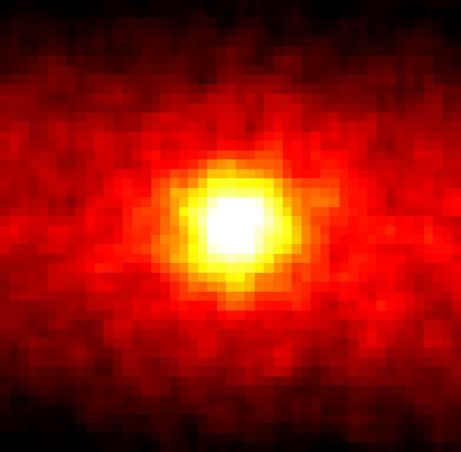 THE SUN, IN NEUTRINOS
This map is built from neutrinos born in fusion reactions at the Sun’s core. Its brighter pixels show the directions where Super-Kamiokande collected more neutrino signals over time.
I look at frontier technology the same way: notice the faint signal early, then follow it toward the real world.
How Super-Kamiokande sees the SunEARLY-STAGE INVESTING · FREES FUND
I look for frontier technologies with the potential to leave the lab, enter the world, and reshape how an industry works.
About FreeS FundMY INVESTMENT LENS
What has changed at the level of science or engineering—and why is it possible now?
Which real constraint does the technology remove, and who cares enough to adopt it?
What does this team understand before the rest of the market sees it?
ONE CURIOSITY, TWO WORLDS
I’m an early-stage investor at FreeS Fund and a particle physicist by training.
My research taught me how to reason from first principles, work at the edge of what is measurable, and stay patient when evidence is scarce. Investing gives me a new way to apply that mindset: finding technical breakthroughs that can become meaningful companies.
I’m most interested in the moment when frontier science begins to answer an urgent industrial need.
From 2019 through August 2025, I worked in experimental particle physics at Northwestern University, studying two of the universe’s most elusive subjects—dark matter and neutrinos. Think of me as a cosmic detective: using cryogenic detectors, rare-event search techniques, and a healthy dose of caffeine to look for particles that rarely leave a trace.
Under the guidance of my advisor, Enectalí Figueroa-Feliciano, and alongside brilliant collaborators, I’ve developed a diverse skill set, from building theoretical models to developing software pipelines that make sense of endless data streams. Python and C++ are basically my second and third languages, and I’ve used them to optimize simulations and hunt for particle-shaped needles in cosmic haystacks. I’ve even had the honor of presenting my findings at international conferences, proving that particle physics isn’t just a lab job—it’s a global effort where everyone is equally baffled but incredibly determined.
That chapter of experimental work ended in August 2025, but its habits remain central to how I think: test assumptions, respect the evidence, and stay curious when the signal is faint. I now bring that mindset to early-stage technology investing.
EXPERIMENTS & COLLABORATIONS
Experimental work completed in August 2025.
My work focused on measuring coherent elastic neutrino–nucleus scattering (CEνNS) at a nuclear reactor, using cryogenic detectors sensitive to the smallest recoils.
Explore the experiment
I searched for dark matter particles lighter than ten proton masses. A tiny signal could open a window into an entirely new world of particles.
Explore the experimentFROM QUESTIONS TO PAPERS
Selected work, explained in plain language.
SHARING THE SCIENCE
Let’s compare notes.